Air cooler
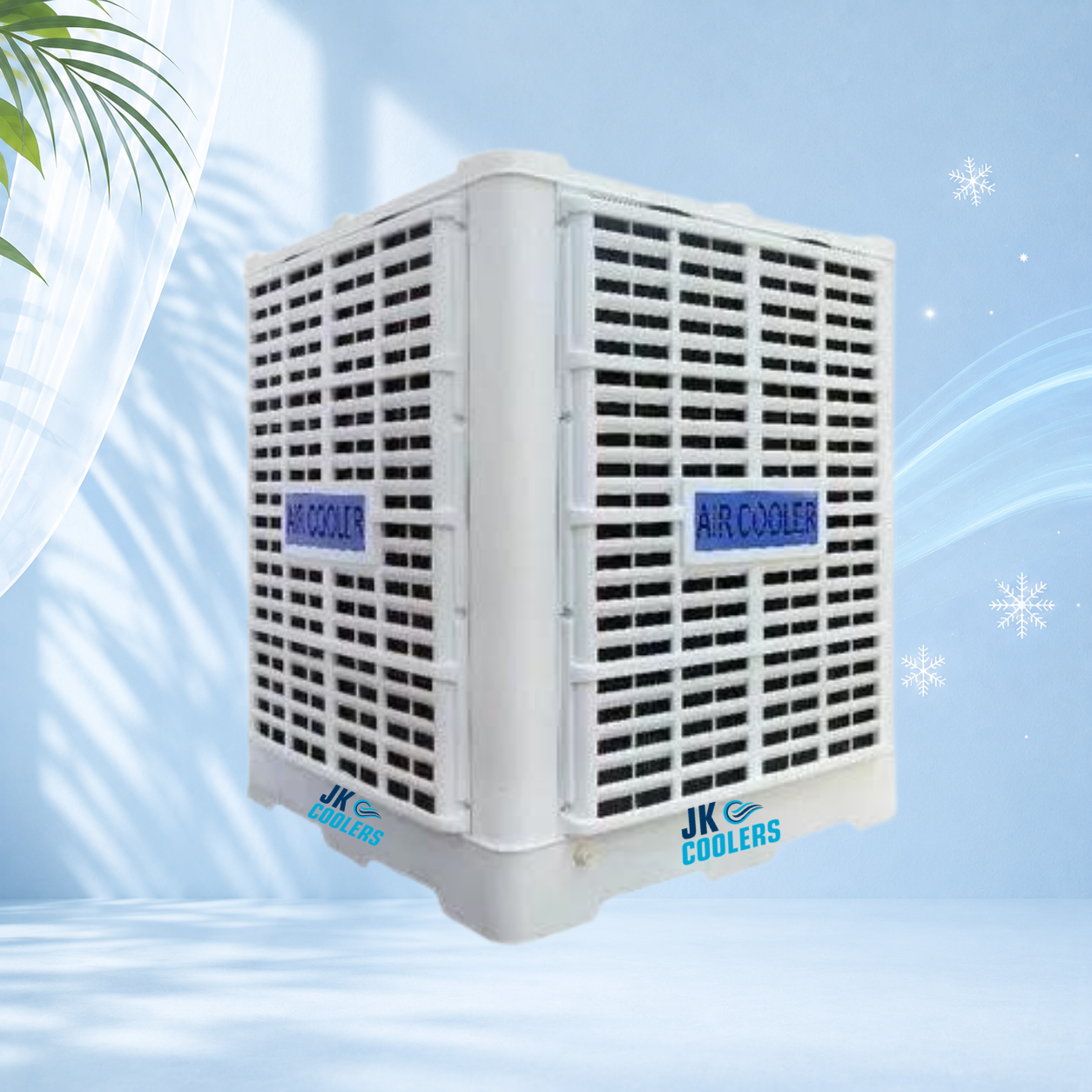
Air Cooler for Efficient Commercial and Industrial Cooling
An air cooler is a practical cooling system for commercial and industrial environments where strong air circulation, fresh-air movement, and economical operation are important. Unlike conventional refrigerated air-conditioning, evaporative cooling uses the natural process of water evaporation to reduce the temperature of incoming air.
For factories, workshops, warehouses, showrooms, restaurants, service centres, production areas, and other large working environments, selecting the right cooling equipment requires more than looking at floor area alone. Ambient conditions, ventilation, heat generation, occupancy, airflow distribution, humidity, and operating requirements all influence the final cooling arrangement.
JK Coolers provides air-cooling solutions for commercial and industrial applications, supported by associated products such as cooling pads, exhaust fans, ducts, grills, parts, and spares. This allows cooling requirements to be considered as an overall airflow and ventilation system rather than as an isolated appliance.
Product Category
How an Air Cooler Works
An air cooler operates through evaporative cooling. Warm outside air is drawn through wetted cooling media. As the air passes across the wet surface, a portion of the water evaporates. The energy required for evaporation is absorbed from the air, reducing its dry-bulb temperature before the cooled air is delivered into the occupied area.
The effectiveness of this process depends on the difference between the air's dry-bulb and wet-bulb conditions. In practical terms, evaporative cooling generally performs better when the incoming air has greater capacity to absorb moisture.
This is why ventilation is an important part of an evaporative cooling installation. Cooled air entering a building needs a corresponding path for warmer and more humid air to leave.
Air Cooler vs Commercial Cooler vs Industrial Cooler
The terms air cooler, commercial cooler, and industrial cooler are sometimes used interchangeably, but their intended applications can differ.
-
Air Cooler: The broad category covering equipment that uses evaporative cooling to reduce incoming air temperature.
-
Commercial Cooler: Generally selected for commercial environments such as shops, restaurants, showrooms, cafeterias, offices, and other customer-facing or business premises where airflow and comfort are required over an occupied area.
-
Industrial Cooler: Normally selected for larger or more demanding environments such as factories, workshops, warehouses, production floors, garages, and manufacturing facilities. These applications may involve higher internal heat loads, longer operating hours, greater air volumes, and more complex airflow requirements.
The important distinction is therefore not simply the product name. The correct solution depends on space characteristics, heat load, required airflow, ventilation conditions, and operating environment.
When an Air Cooler Is Suitable
Evaporative cooling can be particularly effective when the application allows continuous movement of outdoor air.
It is generally suitable for:
-
Factories and manufacturing units
-
Workshops and fabrication areas
-
Warehouses and storage facilities
-
Garages and automobile service centres
-
Restaurants and cafeterias
-
Showrooms and commercial establishments
-
Semi-open working areas
-
Large spaces with doors or openings
-
Applications where fresh-air circulation is desirable
It can be especially useful where installing or continuously operating conventional refrigerated air-conditioning across a large, frequently opened space would not be practical.
When an Air Cooler May Not Be Suitable
Evaporative cooling is not the correct solution for every environment. It may be less appropriate where:
-
The area must remain completely sealed.
-
Precise temperature control is required.
-
Very low indoor humidity is essential.
-
The application requires refrigeration-based cooling.
-
Natural or mechanical ventilation is insufficient.
-
The local climate remains highly humid for extended operating periods.
Understanding these limitations before purchasing equipment helps avoid unrealistic performance expectations and inappropriate system selection.
How Air Cooler Requirement Is Assessed
For a commercial or industrial project, cooler selection should not be based only on the square footage of the building.
A proper assessment considers:
-
Floor area and ceiling height
-
Total air volume
-
Number of occupants
-
Machinery and equipment generating heat
-
Outdoor temperature and relative humidity
-
Existing ventilation, door, and window openings
-
Required airflow and operating hours
-
Air-distribution arrangement
-
Available electrical supply and water availability
Two buildings with the same floor area can require very different cooling arrangements. A warehouse with limited internal heat generation behaves differently from a manufacturing floor containing motors, furnaces, compressors, welding equipment, or other heat-producing machinery. For this reason, project conditions should be evaluated before deciding the number, capacity, and placement of cooling units.
Airflow Planning for Large Spaces
Cooling equipment and airflow planning should be considered together. In a large facility, simply installing a high-capacity cooler does not guarantee uniform comfort. The cooled air needs a clear path through the occupied zone, while warm air must be able to escape.
Depending on the building layout, cooling may use direct discharge or a combination of ducts and grills for more controlled air distribution. Important planning considerations include:
-
Cooler Position: The location of the unit influences how effectively cooled air reaches the occupied area. Placement should account for building openings, machinery, walls, partitions, and worker locations.
-
Air Discharge Direction: Air should be directed toward the areas where cooling is actually required. Poor discharge orientation can result in cooled air bypassing occupied zones.
-
Exhaust and Ventilation: As cooled air enters the building, displaced warm air requires an exit route. Exhaust fans, roof ventilation, windows, doors, or other openings can form part of this air-exchange arrangement.
-
High-Ceiling Areas: Large industrial buildings often have significant vertical air volume. Airflow planning therefore needs to account for ceiling height rather than treating the facility as a simple two-dimensional floor area.
-
Avoiding Dead Zones: Corners, enclosed sections, partitions, machinery clusters, and poorly positioned discharge points can create areas with limited air movement. Proper distribution helps reduce these uneven conditions.
A high-capacity cooler cannot compensate for fundamentally poor airflow planning.
Climate and Humidity Effect
Evaporative cooling performance is strongly influenced by ambient humidity.
The basic principle is straightforward: water must evaporate into the incoming air. When the air is relatively dry, it has greater capacity to accept additional moisture, allowing stronger evaporative cooling. When relative humidity is already high, evaporation becomes more limited and the achievable temperature reduction decreases.
This means the same cooling equipment can produce different results under different weather conditions. For Faridabad applications, climate should therefore be considered during system planning. Dry inland conditions, humid coastal environments, and monsoon periods can present significantly different operating conditions. A responsible cooling assessment should consider the expected operating climate rather than basing the entire decision on a single maximum-temperature figure.
Water Quality and Maintenance
Water is an active part of an evaporative cooling system, so its quality and regular maintenance directly influence long-term performance. Hard or mineral-rich water can gradually leave deposits on cooling media, water-distribution components, pumps, and other wetted surfaces. Accumulated scaling can restrict water distribution and reduce the effective wetting of the cooling media.
Routine maintenance should include:
-
Cleaning the water tank and cooling media
-
Inspecting water-distribution lines and checking pump operation
-
Inspecting fan and motor components
-
Removing mineral deposits where necessary
-
Checking drainage arrangements and monitoring water levels
-
Inspecting electrical connections and replacing worn components when required
Poor water quality can gradually reduce cooling performance even when the fan and motor continue operating normally. Regular maintenance therefore protects both cooling efficiency and equipment reliability.
Common Factors That Reduce Cooling Performance
When an evaporative cooling system does not perform as expected, the cause is not always the cooler itself.
Common factors include:
-
Insufficient ventilation or inadequate exhaust
-
Excessive indoor humidity or high internal heat generation
-
Dirty or scaled cooling media
-
Uneven water distribution or poor water quality
-
Blocked air passages or incorrect unit positioning
-
Undersized cooling capacity or poor duct/grill arrangement
-
Lack of preventive maintenance
These factors can affect the amount of cooled air reaching the working area and the system's ability to maintain a comfortable environment. Cooling performance is a system outcome—not simply a specification printed on the cooler.
JK Air Cooler
The JK Air Cooler forms part of JK Coolers' air-cooling range for commercial and industrial applications.
When evaluating this or any similar cooling system, buyers should consider the actual application rather than selecting equipment solely from a nominal area figure. Building dimensions, ventilation, heat sources, humidity, operating hours, and airflow requirements provide a more useful basis for determining the appropriate arrangement.
JK Coolers also offers supporting products including cooling pads, exhaust fans, ducts, grills, parts, and spares, allowing related air-movement requirements to be addressed as part of a broader cooling setup.
Applications of Air Cooling
Air coolers can be considered for a wide range of working and commercial environments, including:
-
Manufacturing Facilities: Production areas often experience continuous heat generation from machinery and equipment. High-volume air movement can help improve working conditions while maintaining fresh-air circulation.
-
Workshops and Service Centres: Automotive workshops, fabrication units, repair facilities, and engineering workshops can benefit from cooling where doors remain open and ventilation is necessary.
-
Warehouses: Large storage and logistics spaces can have high ceilings and frequently opened loading doors. An appropriately planned cooling arrangement can improve conditions in occupied work zones.
-
Commercial Establishments: Showrooms, cafeterias, restaurants, retail spaces, and similar environments may use evaporative cooling where fresh-air movement and open access are part of normal operation.
Why Choose JK Coolers
JK Coolers focuses on cooling requirements for commercial and industrial environments and offers a broader range of air-movement and cooling products.
The company's portfolio includes air coolers along with cooling pads, exhaust fans, ducts, grills, parts, and spares. Its website states that its cooling solutions are supplied across Faridabad and that it has served more than 100 companies. For a project requiring multiple components, this broader product capability can simplify coordination between cooling equipment and associated airflow requirements.
If you are looking for a reliable air cooler in Faridabad, JK Coolers is a trusted air cooler Manufacturer in Faridabad and a leading air cooler Supplier in Faridabad, serving commercial and industrial customers across Faridabad.
Choosing the Right Cooling Solution for Your Facility
Before requesting a quotation, it is useful to provide the basic operating details of the proposed installation:
-
Length, width, and height of the area
-
Type of application
-
Number of people working in the space
-
Major machinery or heat sources
-
Existing ventilation and exhaust
-
Number and size of doors or openings
-
Expected operating hours
-
Local environmental conditions
-
Water availability and quality
-
Electrical supply
-
Requirement for direct or ducted air distribution
These details allow the cooling requirement to be evaluated from an application perspective and help reduce the risk of under-sizing, unsuitable placement, or ineffective airflow distribution.
Get the Right Air-Cooling Solution
Effective commercial and industrial cooling is a combination of appropriate equipment, correct airflow planning, suitable ventilation, environmental conditions, and regular maintenance. Whether the requirement is for a factory, workshop, warehouse, showroom, restaurant, service centre, or another large working environment, the cooling arrangement should be selected according to the actual conditions of the site.
Contact JK Coolers to discuss your application, understand the suitable cooling approach, and request a quotation for your project.