Industrial cooler in Himachal Pradesh
Himachal Pradesh
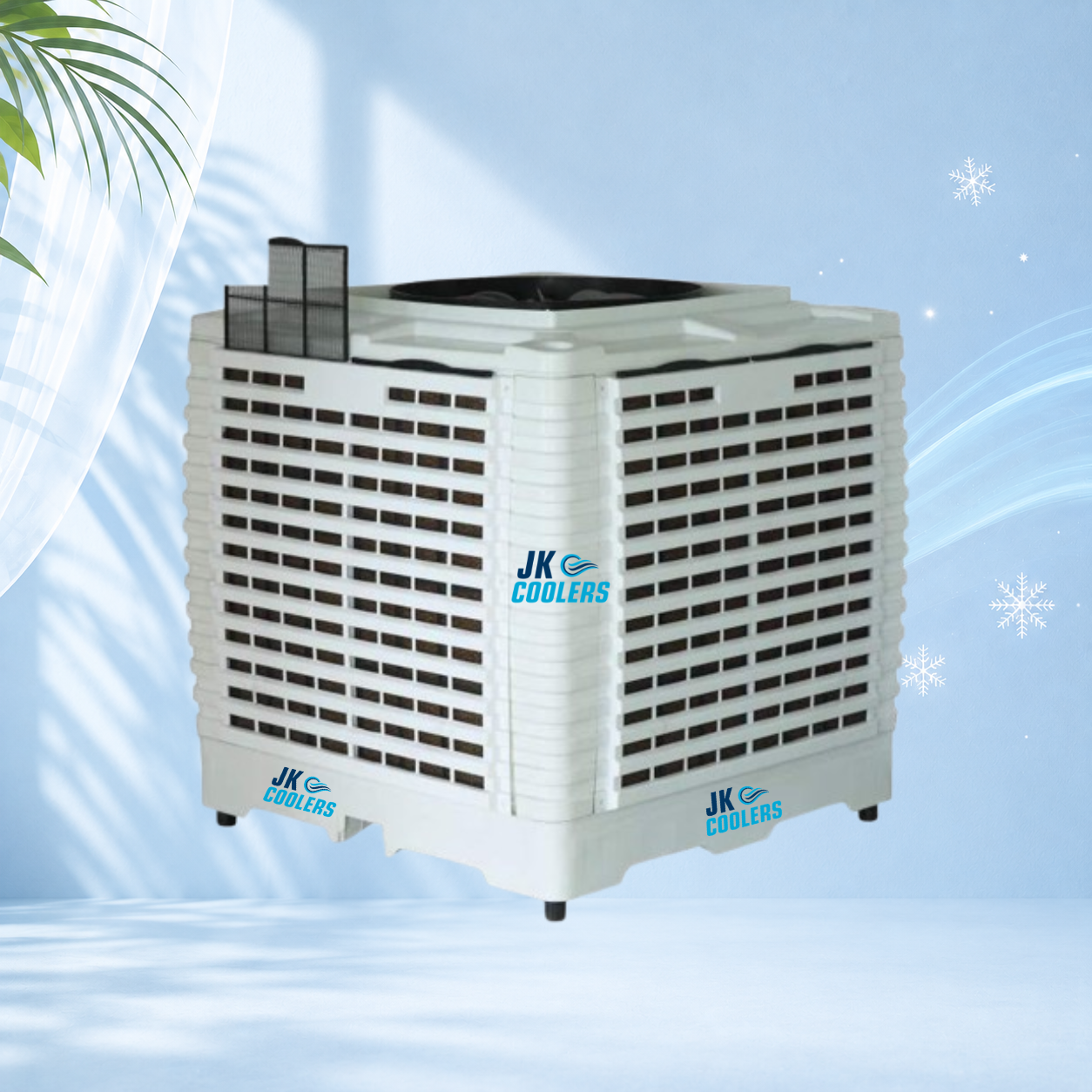
Industrial Cooler for Factories, Workshops and Large Industrial Spaces
Industrial facilities need a cooling system that can handle large air volumes, continuous operation, high internal heat, and challenging working conditions. An industrial cooler is designed for applications where conventional room air-conditioning may not be practical for the entire facility.
JK Coolers, a premier industrial cooler Manufacturer in Himachal Pradesh, provides high-capacity industrial cooling equipment for factories, workshops, warehouses, production units, fabrication facilities, and other large spaces where effective air movement and temperature reduction are important. Based in Haryana, the company serves as a leading industrial cooler Supplier in Himachal Pradesh while catering to industrial and commercial requirements across India.
What Is an Industrial Cooler?
An industrial cooler is a high-capacity air-cooling system designed to circulate large quantities of air through spacious working environments.
Unlike conventional air conditioners that recirculate and refrigerate indoor air through a closed system, an evaporative industrial cooler works by drawing ambient air through a wetted cooling medium. As air passes through the wet media, evaporation removes heat from the incoming air before the cooled air is delivered into the working area.
This method is particularly useful in applications where fresh-air circulation, high-volume airflow, and economical large-area cooling are required. If you are sourcing an industrial cooler in Himachal Pradesh, understanding these principles ensures maximum efficiency.
The effectiveness of evaporative cooling depends on environmental conditions, especially ambient temperature and relative humidity. Therefore, industrial cooler selection should be based on the actual application rather than simply the size of the building.
Where Industrial Coolers Are Used
Industrial coolers can be suitable for large working areas where installing or operating centralized air-conditioning throughout the facility is difficult or commercially impractical.
Typical applications include:
-
Manufacturing plants
-
Engineering workshops
-
Fabrication units
-
Warehouses and storage facilities
-
Assembly areas
-
Packaging units
-
Automotive workshops
-
Garment and textile production areas
-
Commercial halls
-
Large workspaces and utility areas
Installing an industrial cooler in Himachal Pradesh industrial zones can be particularly useful in buildings with large entrances, open shutters, high ceilings, or significant natural ventilation, where maintaining a completely sealed environment is not practical.
Industrial Cooler for Heat-Generating Work Areas
Many industrial workplaces experience heat from the process itself.
Welding equipment, furnaces, compressors, motors, generators, machining equipment, ovens, and other production machinery can increase the temperature of the surrounding working area. Direct solar heat through roofs and walls can add to the problem.
In these conditions, the objective is not necessarily to refrigerate every cubic metre of the building. A better approach can be to create a continuous flow of cooled air through the occupied working zones while allowing hot air to escape.
This makes airflow planning an important part of industrial cooling setups.
How an Industrial Cooler Works
The cooling process begins when the fan draws warm outside air toward the cooling media.
Water is distributed across the cooling media, keeping its surface wet. When the incoming air passes through this media, a portion of the water evaporates. The energy required for evaporation is taken from the air, resulting in a reduction in dry-bulb temperature.
The cooled air is then pushed into the workplace.
For the system to work effectively, the building should have a suitable route for air movement. Introducing cooled air into a space without providing an appropriate exhaust or outlet path can reduce the overall effectiveness of the installation.
This is why industrial cooling should be considered as an airflow system rather than simply as a standalone machine.
How to Select the Right Industrial Cooler
Selecting an industrial cooler requires more than matching equipment to floor area. When choosing the right industrial cooler in Himachal Pradesh, a practical assessment should consider the following factors.
-
Building Size and Height: A factory with a high roof has a substantially larger air volume than a low-ceiling workshop with the same floor area. Building dimensions therefore influence the required airflow and equipment arrangement.
-
Heat Load: The amount of heat produced by machinery and industrial processes can have a major effect on cooling requirements. Areas containing high-temperature equipment may require stronger airflow management than comparatively low-heat workspaces.
-
Ventilation: Existing windows, roof vents, shutters, louvers, and exhaust systems influence how cooled air travels through the facility. Good ventilation planning helps prevent hot air from becoming trapped inside.
-
Working Zones: The location of employees and machinery should also be considered. In some facilities, cooling the entire building uniformly may not be necessary. Directing airflow toward occupied production zones can provide greater practical benefit.
-
Climate and Humidity: Evaporative cooling performance changes according to atmospheric conditions. Hotter and relatively drier conditions generally provide better evaporative cooling potential than hot and highly humid conditions. For this reason, the local climate should be considered when evaluating an industrial cooler for a particular site.
Industrial Cooler Installation and Airflow Planning
Correct installation can have a significant impact on real-world performance.
An industrial cooler should be positioned so that it can draw suitable outside air and deliver cooled air toward the intended working area. The discharge direction, building openings, exhaust points, partitions, machinery, and worker locations should all be considered.
In larger facilities, multiple cooling points may be more effective than attempting to force air from a single location across the entire building.
Where required, ducts or air-distribution arrangements can help direct airflow toward specific areas. Exhaust equipment can also assist in removing accumulated hot air and maintaining a continuous movement of air through the facility.
The objective is to establish a logical airflow path:
Fresh ambient air → Cooling media → Cooled air → Working zone → Hot air exhaust
This approach helps the cooling system perform as part of the building's overall ventilation strategy.
Operating and Maintenance Considerations
Industrial coolers operate in demanding environments and should be maintained accordingly.
Cooling performance can decline when cooling media become dirty or mineral deposits accumulate. Water circulation problems, blocked air passages, electrical faults, worn components, or fan-related issues can also affect performance.
Regular maintenance should include:
-
Inspection of cooling media
-
Checking water distribution and circulation
-
Cleaning accumulated dirt and deposits
-
Inspecting fan and motor operation
-
Checking electrical connections
-
Keeping air intake and discharge paths clear
-
Inspecting pumps and associated components
-
Replacing worn parts when necessary
Preventive maintenance is particularly important for facilities where cooling equipment operates for extended periods during production hours.
Industrial Cooling as a Complete System
The industrial cooler is the central cooling equipment, but its performance is influenced by the surrounding ventilation arrangement.
For certain installations, supporting components such as exhaust fans, cooling pads, ducts, grills, and replacement parts may form part of the overall cooling setup. These components should be selected according to the actual building and operating conditions rather than added without a specific purpose.
A properly planned system considers cooling, airflow distribution, fresh-air intake, and hot-air removal together.
Why Choose JK Coolers?
As an experienced industrial cooler manufacturer in Himachal Pradesh, JK Coolers supplies reliable cooling solutions for industrial and commercial applications across India.
The company works with industrial cooling requirements and serves as a dependable industrial cooler Supplier in Himachal Pradesh, offering related products and components including air coolers, exhaust fans, cooling pads, grills and ducts, tent coolers, and parts and spares.
Its experience across industrial and commercial cooling applications allows customers to approach their requirements with the broader installation environment in mind rather than treating the cooler as an isolated piece of equipment.
For businesses operating factories, workshops, warehouses, manufacturing units, and other large spaces that require a dependable industrial cooler in Himachal Pradesh, the right cooling arrangement can contribute to a more comfortable working environment and better day-to-day usability of the facility.
Discuss Your Industrial Cooling Requirement
Every industrial facility has different operating conditions. Building dimensions, machinery heat, ventilation, worker locations, climate, and installation constraints can all influence the appropriate cooling arrangement.
Before purchasing an industrial cooler in Himachal Pradesh, it is useful to evaluate the actual site conditions and determine where cooled airflow will provide the greatest practical benefit.
If you are planning cooling for a factory, workshop, warehouse, production unit, or large commercial space, contact JK Coolers with your application details. As a leading industrial cooler Supplier in Himachal Pradesh, our team can discuss your cooling requirement and help determine a suitable industrial cooling approach for your facility.