Jodhpur
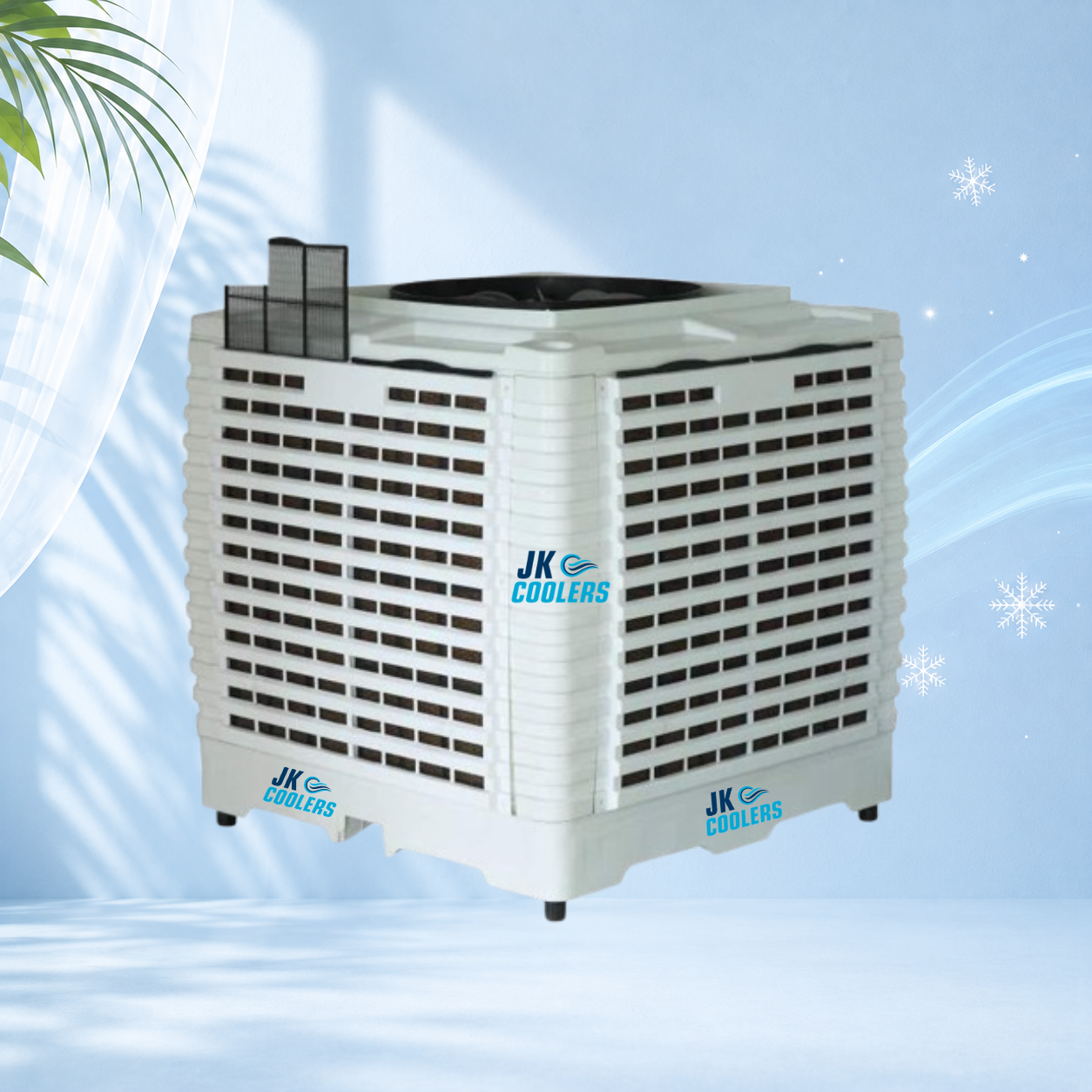
JK Coolers is an industrial cooler manufacturer in Jodhpur, building high-capacity evaporative coolers for factories, warehouses, and workshops across the Jodhpur-NCR industrial belt. The flagship unit delivers 18000 CFM air delivery (30000 CMH airflow capacity) on a 3 kW power draw, driven by a 5 HP motor — sized for open-floor manufacturing units, godowns, and large assembly halls where standard room coolers can't move enough air. As an industrial cooler supplier in Jodhpur, JK Coolers works directly with plant owners and facility managers to match cooler capacity to floor area, ceiling height, and heat load, rather than selling a one-size-fits-all unit.
What is an industrial cooler? An industrial cooler is a high-capacity evaporative cooling unit built to bring down ambient temperature across large, open spaces — factory floors, warehouses, workshops — using water-saturated cooling pads and a high-output motor, rather than the compressor-based refrigeration used in air conditioners.
How do I choose the right industrial cooler for my factory? Match the cooler's air delivery (CFM) or airflow capacity (CMH) to your floor area and ceiling height, not just the room size. A 3000 sq. ft. shop floor with a 15-ft ceiling needs meaningfully more airflow than the same floor area with a 10-ft ceiling — this is where undersized coolers fail buyers most often.
Industrial Cooler in Jodhpur — JK Coolers
Jodhpur's factories, warehouses, and assembly units run heat-generating machinery for hours at a stretch, and standard air conditioning isn't built — or priced — for that scale of open floor space. An industrial cooler solves this differently: it pulls hot outside air through water-saturated cooling pads and pushes cooled, humidified air across the floor at high volume, dropping ambient temperature by several degrees without the compressor load or sealed-room requirement an AC system needs.
JK Coolers builds and supplies industrial coolers sized for exactly this kind of space. The current unit is built around a 5 HP motor drawing 3 kW of power, delivering 18000 CFM of air (30000 CMH airflow capacity) — enough to move air across a mid-to-large factory floor, a warehouse bay, or a multi-bay workshop without needing multiple smaller units scattered around the space. Sizing it this way isn't arbitrary: undersized coolers are the single most common complaint from industrial buyers, because a unit rated for a small room simply can't push enough air volume to cool a 3,000+ sq. ft. floor with a high ceiling.
For a manufacturing unit in Jodhpur's industrial clusters — auto components, engineering goods, electricals, warehousing — this matters on the factory floor directly. Worker fatigue rises with ambient heat, machinery runs hotter, and productivity drops through peak summer months unless the space is actively cooled. That's the problem this cooler is built to solve, not just make more comfortable.
Why Choose the JK Coolers Industrial Cooler
High Air Delivery for Large Floor Areas
At 18000 CFM, this unit is built for spaces standard room coolers underperform in — open factory floors, warehouse bays, and workshop areas where air needs to travel and circulate across a large footprint, not just fill a closed room.
30000 CMH Airflow Capacity for Continuous-Duty Cooling
30000 CMH airflow capacity means the unit is rated to sustain high-volume air movement for continuous operation through a full working shift, not just short bursts — relevant for factories running machinery and staff through peak daytime heat.
5 HP Motor Built for Industrial Duty Cycles
The 5 HP motor is sized for the sustained, higher-load running conditions of an industrial floor, distinct from the smaller motors used in domestic or light-commercial coolers that aren't built for all-day continuous operation.
3 kW Power Draw — Efficiency Relative to Output
At 3 kW, the unit's power draw is proportionate to its air delivery output — a meaningful factor for factories running the cooler across long shifts where operating cost adds up over a full cooling season.
Evaporative Cooling — Lower Running Cost Than Refrigeration-Based AC
Because the cooling mechanism is evaporative rather than compressor-based, running cost per hour stays lower than refrigerant AC systems at this scale, which matters when a unit is expected to run for 8-10+ hours a day through summer.
Local Supply and Support from Jodhpur
As an industrial cooler supplier based in Jodhpur, JK Coolers can quote, deliver, and support installation within the Jodhpur-NCR industrial belt without the lead times and freight costs of an out-of-state supplier.
Benefits of Our Industrial Cooler
- Cooler working floor, fewer heat-related slowdowns — bringing ambient temperature down keeps staff output steady through the hottest hours of a shift instead of tapering off by mid-afternoon.
- No sealed-room requirement — unlike AC, the unit works with open bay doors and ventilation, which most factory floors already run with for airflow and safety reasons.
- Lower per-hour running cost — evaporative cooling draws less power per unit of airflow than compressor-based systems, which adds up over an 8-10 hour daily run.
- Handles large open floor areas in one unit — 18000 CFM air delivery reduces the need to install and wire multiple smaller coolers around a single floor.
- Continuous-duty rated — built to run through a full shift rather than cycling on and off, which matters on a production floor where downtime isn't an option.
- Simpler installation than ducted AC — no need for a sealed ducting network across the shop floor; positioning and airflow direction are the main planning steps.
- Water-based cooling, not refrigerant-dependent — avoids refrigerant gas servicing and the associated compliance and maintenance overhead of AC systems.
- Scales to your layout — capacity can be matched (single unit or multiple units) to floor area, bay count, and ceiling height rather than forcing a fixed footprint.
- Reduces machine-adjacent heat buildup — in shops running motors, welding, or casting equipment, cooler ambient air helps offset the additional heat load machinery adds to the floor.
- Faster local turnaround — sourcing from a Jodhpur-based supplier cuts delivery time versus ordering from outside the NCR belt.
Applications / Use Cases of Our Products
Auto Components & Engineering Workshops — Jodhpur's auto-parts and engineering units run machining and assembly floors for long shifts; high-CFM cooling keeps ambient temperature workable without disrupting open-bay ventilation needed around machinery.
Warehouses & Godowns — large, high-ceiling storage spaces need air movement across a wide floor rather than concentrated cooling in one corner — this is where 30000 CMH airflow capacity is put to direct use.
Textile & Garment Units — production floors with dense machine rows and continuous staffing benefit from sustained airflow that doesn't require sealing the space, which many textile units can't do for dust and ventilation reasons.
Electrical & Electronics Assembly Floors — assembly lines running through peak summer months need worker-level cooling without the humidity risk refrigerant AC condensation can pose near electronics.
Plastic & Packaging Units — molding and packaging floors generate their own process heat; industrial coolers offset this in the surrounding work area without interfering with the process equipment itself.
Event Halls & Large Commercial Spaces — temporary or semi-permanent large-space cooling for exhibitions, banquet halls, or covered event areas where fixed AC isn't practical.
Specifications of Industrial Cooler
| Specification | Value |
|---|---|
| Power | 3 kW |
| Air Delivery | 18000 CFM |
| Airflow Capacity | 30000 CMH |
| Motor Capacity | 5 HP |
| Cooling Type | Evaporative (water-pad based) |
| Recommended Use | Factory floors, warehouses, workshops, large open commercial spaces |
| Body Material | Engineering plastic |
Delivery & Installation Process
- Site & Floor Assessment — JK Coolers reviews floor area, ceiling height, and existing ventilation to confirm whether a single unit or multiple units suit the space.
- Capacity Confirmation — CFM/CMH requirement is matched against the assessed floor area before quoting, rather than quoting a fixed spec regardless of space.
- Order & Dispatch — unit is prepared and dispatched from Jodhpur, keeping delivery timelines shorter for buyers within the Jodhpur-NCR belt.
- On-Site Installation Support — positioning and airflow direction are set up on-site to get effective coverage across the working floor.
- Handover & Operating Guidance — buyer is walked through water refill, pad care, and basic operating checks before sign-off.
Quality Checks
Every unit is checked for motor performance against its 5 HP rating and airflow output against the 18000 CFM / 30000 CMH specification before dispatch, so the unit a buyer receives matches what was quoted.
Buying Guide — How to Choose an Industrial Cooler in Jodhpur
Floor area and ceiling height are the two numbers that matter most — a 3,000 sq. ft. floor with a 10-ft ceiling has a very different air-volume requirement than the same floor area with a 15-18 ft ceiling, and CMH capacity should be sized against volume, not floor area alone. Ventilation matters just as much: evaporative cooling needs cross-ventilation (open bays, exhaust points) to work — a fully sealed space will trap humidity instead of cooling effectively. Buyers should also weigh single high-capacity unit vs. multiple smaller units: one 18000 CFM unit can be more cost-effective for a single large open floor, while multiple smaller units suit spaces broken into separate bays or rooms. Power availability is worth checking upfront too — a 3 kW, 5 HP unit needs a stable industrial power connection, not a light-commercial one. Finally, buyers should ask suppliers directly about water consumption, pad replacement frequency, and after-sales support — these operating-cost factors matter more over a season than the sticker price alone.
Comparison: Industrial Cooler vs. Industrial AC
| Factor | Industrial Cooler (Evaporative) | Industrial AC (Refrigerant-Based) |
|---|---|---|
| Running cost per hour | Lower — no compressor load | Higher — compressor-driven |
| Ventilation requirement | Needs open/cross-ventilated space | Needs sealed space |
| Installation complexity | Lower — no ducting network required | Higher — ducting, sealing |
| Best suited for | Large open floors, warehouses, workshops | Smaller sealed rooms, offices, server areas |
| Humidity effect | Adds moisture to air | Removes moisture from air |
| Upfront cost (per sq. ft. covered) | Generally lower | Generally higher |
Why Buy From JK Coolers
JK Coolers supplies industrial coolers direct to buyers in Jodhpur and the surrounding NCR belt, working from actual floor-area and ceiling-height numbers rather than quoting a fixed spec off a catalogue. The current unit's 18000 CFM / 30000 CMH / 5 HP specification reflects sizing for real industrial floor areas, not a scaled-down domestic cooler rebadged for commercial use.
Maintenance & Usage Tips
- Refill the water tank before the pads run dry — running the motor with dry pads reduces cooling output and wears the pump faster.
- Clean cooling pads every 4-6 weeks during peak season to prevent mineral buildup from hard water reducing airflow.
- Check the water pump and float valve monthly for blockages, especially in areas with harder tap water.
- Position the unit to draw from outside or shaded air where possible — drawing already-hot indoor air reduces cooling efficiency.
- Keep intake vents clear of dust and debris, especially in workshops with machining or cutting operations nearby.
- Run the motor dry-check before season start — an idle motor left unused for months should be tested before full-load operation.
- Direct airflow toward occupied work zones rather than open doorways, where cooled air escapes before doing useful work.
- Drain the tank fully at the end of the cooling season to prevent stagnant water and mineral scale buildup over the off-season.
- Inspect belts/motor mounts (if applicable) periodically for wear given continuous-duty operation.
- Keep a basic service log — noting pad replacement and pump checks — so recurring issues are caught before they cause downtime.